Across conditions and tolerances
Designs are optimised across the whole envelope the robot will meet, including low light, glare, rain, dust and motion, and across the variation real components show against their datasheets.
Robotics and autonomous systems
A design platform that optimises a robot's sensing hardware and its perception model together, for one operational decision. It simulates how light, optics and the sensor shape every signal, then finds the leanest configuration that still decides reliably across real conditions.
The problem
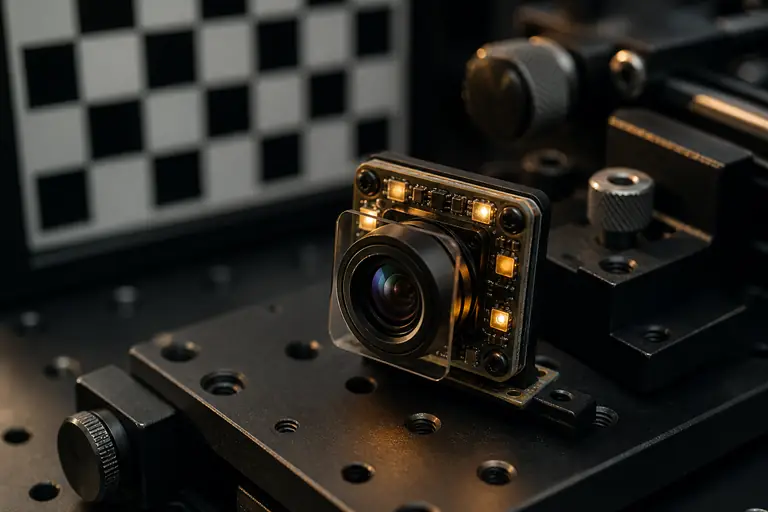
Most robots get the best camera the budget allows, and the perception model is trained on whatever that camera produces. The sensor ends up capturing far more than the task needs, while spending power, bandwidth, compute and mass, and it can still miss the one cue that matters.
The approach
The platform treats the sensor and the model as a single system with a single job. It works backwards from the decision the robot has to make, through the physics of how a signal is formed, to the hardware and model that make that decision for the least cost.
What the robot must decide, what each kind of error costs, the conditions it will work in, and the limits on power, mass, data rate and price.
A physically grounded simulation of how illumination, optics, filtering and the sensor itself shape the signal that reaches the model, across the full range of operating conditions.
Hardware and perception model are tuned as one, against how reliably the decision is made and what it costs. Image quality is never the objective.
An optical and illumination specification, a component list drawn from real parts, sensor settings, a trained model, and predicted performance with honest uncertainty.
Measurements from each prototype feed back into the simulation, so every build narrows the gap between what was predicted and what the hardware does.
What changes
Trade-off explorer
For a given decision, the platform maps the leanest design that reaches each level of reliability. A camera chosen for image quality usually sits well above that curve: it pays for capability the decision never uses. Move the slider to set how reliable the decision has to be.
The leanest design needs a fraction of the conventional camera's resources.
Built to hold up
A sensor designed for one decision has to keep making it when the world stops cooperating. Reliability is designed in from the first simulation, not tested in at the end.
Designs are optimised across the whole envelope the robot will meet, including low light, glare, rain, dust and motion, and across the variation real components show against their datasheets.
A sensor shaped around a decision collects less incidental detail. That means less data to move, store and protect if a device is lost or captured.
Each prototype corrects the simulation that designed it, so predictions get closer to the hardware with every build.
Every design ships with its operating envelope and predicted performance with uncertainty, ready for the validation that safety-critical and regulated deployments demand.
Applications
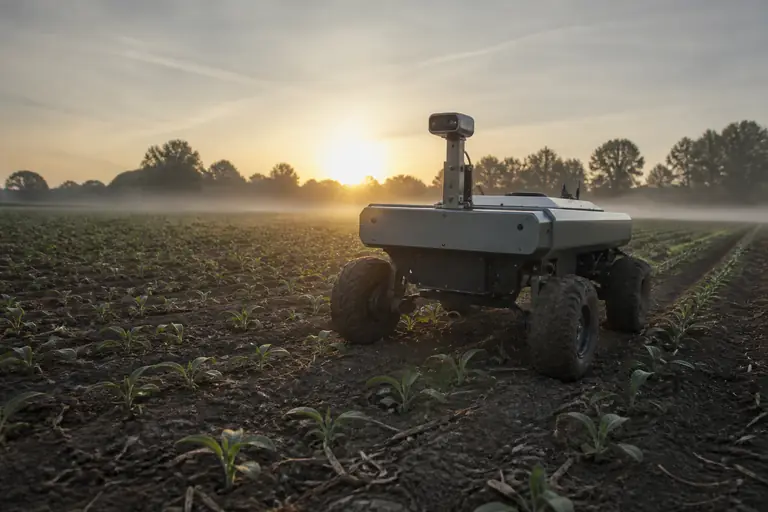
Long days on battery, changing light and dirt on the optics. Spending power only on the cues that matter extends every shift.
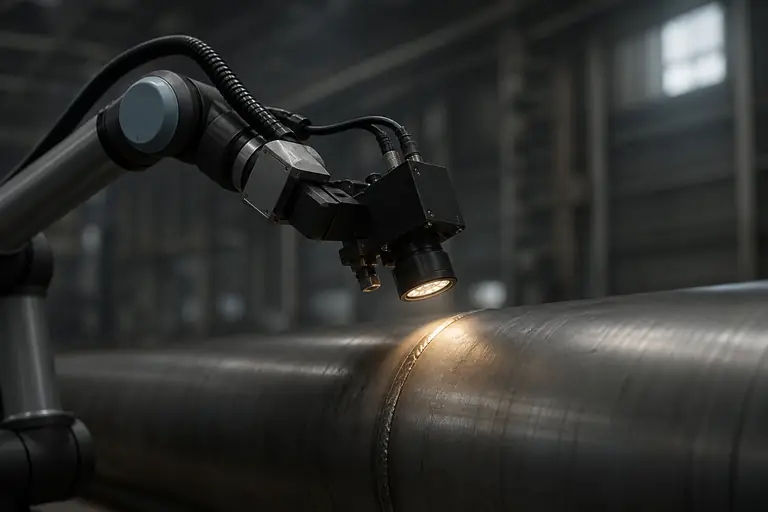
Pass or fail, defect or sound. A decision this specific rewards a sensor built around it.
Drones, wearables and space
Where size, weight and power decide the whole platform.
Logistics
Fleets of robots, each a little cheaper and each running a little longer.
Defence and security
Capture less, transmit less, expose less.
Status
The programme is at concept stage. The first milestone is a single binary decision on a single platform, such as obstacle detection on a small ground robot or a pass or fail inspection call. The co-designed system will be compared with the best affordable conventional camera on decision reliability across conditions, power, data rate and component cost, then built and tested on real hardware.
Partnering
The programme is looking for an implementation partner with a real platform, a real operational decision and the conditions it has to work in. In return, you get a sensor and model designed for exactly that job, and the evidence to show what it saves.
Built by INEVITABLE, an AI research and development company in Salford, UK, working on AI for secure and constrained environments. Selected for the first cohort of the GCHQ Accelerator in Manchester.